
On this page
Killing the Hero Culture: Why I Build Systems That Don’t Need Me
Stage 1: The Psychology of the Hero vs. The Architect of Systems
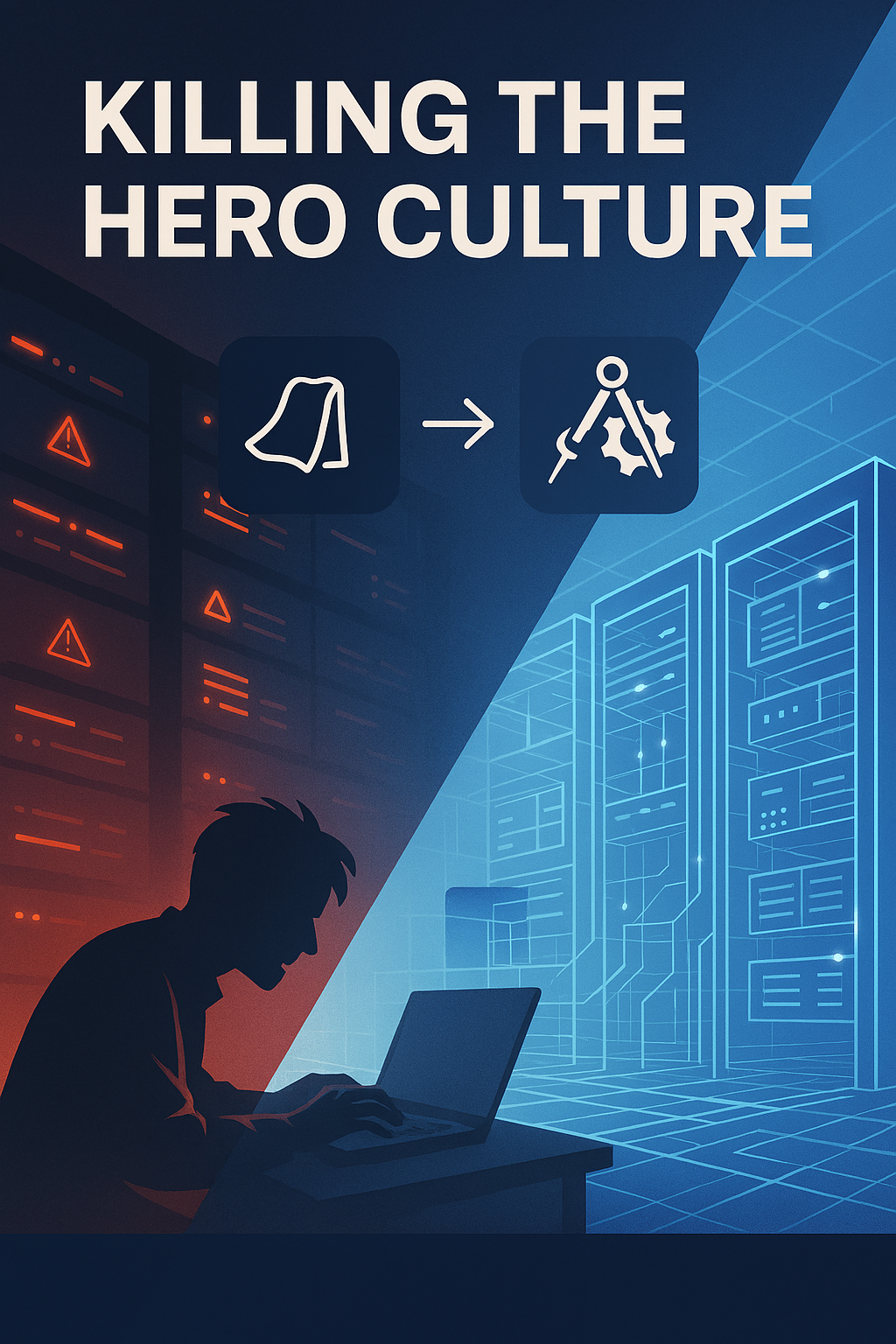
In the landscape of modern enterprise technology, there is a recurring character often celebrated in post-incident reviews and all-hands meetings: the “Hero.” This is the engineer who spends 48 consecutive hours awake during a critical production outage, the one who knows the specific, unwritten command to revive a legacy database, and the one who ultimately “saves the day.” While this individual’s dedication is admirable, their necessity is a glaring indictment of the system’s architecture.
To build for infinite capacity and true operational excellence, we must dismantle the “Hero Culture” and replace it with a philosophy of systemic invisibility.
The Allure and Danger of the Hero Mythos
The industry traditionally rewards the Hero because their impact is visible and dramatic. Managers see a fire, and they see a person putting it out. This creates a dangerous feedback loop where “firefighting” is valued over “fireproofing.”
When an organization relies on heroism, it is effectively operating in a state of high technical debt. The “heroic” act of staying up all night to fix a manual deployment failure is not a badge of honor; it is a symptom of a fragile, manual-heavy process. Relying on individual effort to overcome systemic gaps leads to several critical failures:
- Positive Reinforcement of Failure: If the only way to get recognition is to fix a crisis, engineers may subconsciously (or consciously) deprioritize the “boring” work of automation and hardening that would prevent the crisis in the first place.
- The Scalability Ceiling: A hero has finite energy. You cannot scale a business if every incremental increase in traffic requires a linear increase in human adrenaline.
- Burnout and Attrition: As highlighted in years of State of DevOps (DORA) research, high-stress environments that rely on manual intervention and “crunch time” are the leading predictors of developer burnout.
The “Bus Factor” and the Poison of Tribal Knowledge
One of the most significant risks in a Hero Culture is a low Bus Factor—the minimum number of team members that can be “hit by a bus” before a project or system stalls completely.
Heroes often become the sole gatekeepers of Tribal Knowledge: critical information about how a system works that exists only in their heads and is never documented or codified. This creates a single point of failure that is more dangerous than any hardware malfunction.
- Information Silos: When knowledge is hoarded, even unintentionally, it prevents the team from growing. Junior engineers cannot learn, and peer reviews become superficial because only the “Hero” truly understands the logic.
- Deployment Anxiety: Teams become afraid to change code or push updates if the “Hero” is on vacation, leading to stagnancy and a loss of competitive edge.
- Opaque Systems: If a system requires a specific human’s “touch” to remain stable, it is not an engineered system; it is a craft project.
The Architect Mindset: The Goal of Invisibility
Contrast the Hero with the Architect of Systems. The Architect’s goal is to be completely invisible. In this mindset, the most successful day is the one where nothing “exciting” happens because the system handled every anomaly automatically.
The Architect does not fix the database; they write the code that allows the database to heal itself. They don’t manually patch servers; they build an immutable pipeline that replaces them.
Key Differences in Approach:
| Feature | The Hero Culture | The Architect Mindset |
|---|---|---|
| Primary Tool | Manual Intervention / SSH | Defined Code / CI/CD |
| Knowledge | Tribal & Hoarded | Codified & Transparent |
| Success Metric | Time to Resolve (Manual) | Mean Time Between Failures (Automated) |
| Visibility | High (During Crises) | Low (Constant Stability) |
| Documentation | Non-existent or Outdated | Living Documentation (Runbooks/Code) |
DORA Research and Organizational Performance
The DevOps Research and Assessment (DORA) team has spent years proving that the “Architect” approach is objectively superior for business outcomes. Their research consistently shows that “High Performers” do not have more heroes; they have better systems.
“High-performing organizations are those that move away from the ‘hero’ model. They realize that technical excellence is about creating a environment where failures are expected, handled by the system, and used as learning opportunities rather than occasions for individual heroics.” — Summarized from Accelerate / DORA Research
Organizations that kill the Hero Culture see:
- Lower Change Failure Rates: Because changes are peer-reviewed and automated.
- Higher Deployment Frequency: Because the team trusts the system.
- Better Employee Retention: Because engineers can disconnect and rest, knowing the “Defined Code” has the watch.
Moving Toward “Boring” Engineering
The shift requires a psychological change in leadership. We must stop rewarding the “all-nighter” and start rewarding the “boring” engineer who spent their week writing comprehensive tests and Terraform modules that made the all-nighter unnecessary.
The most beautiful systems are the ones that don’t need us. They are the ones where precision-engineered automation handles the “hard work,” allowing the humans to focus on the next level of innovation. To build for infinite capacity, we must first accept that our own manual involvement is a bottleneck that needs to be engineered out of existence.
Stage 2: The Technical Framework of Self-Healing Systems
To dismantle the hero culture, an organization must transition from a “repair” mindset to a “resilience” mindset. If Stage 1 was about the psychological shift, Stage 2 focuses on the technical architecture required to make human intervention obsolete during common failure modes. By codifying operational intelligence into the infrastructure itself, we move closer to the goal of systems that possess “infinite capacity” for self-correction.
Immutable Infrastructure: Eliminating the “Snowflake” Server
The “Hero” thrives in an environment of “Snowflake” servers—unique configurations that have been manually tweaked over years and cannot be easily replicated. When a Snowflake fails, only the Hero knows how to fix it.
The industry solution is Immutable Infrastructure. In this model, components are never patched or modified in place. If a server needs a change or an update, a new image is built, tested, and deployed to replace the old one.
- Predictability: Because every instance is a carbon copy of a version-controlled image, the system’s state is always known.
- Elimination of Configuration Drift: Automation ensures that production environments remain identical to staging, removing the “it works on my machine” excuses that often precede a call to a hero.
- Rapid Recovery: If an instance becomes unhealthy, the system doesn’t try to “fix” it; it simply terminates the instance and spins up a fresh, known-good replacement.
From Monitoring to Observability
Traditional monitoring is designed for the Hero; it alerts a human when a specific threshold is crossed (e.g., “CPU > 90%”). This forces a human to log in, investigate, and act. Observability, however, is designed for the Architect.
Observability provides the deep telemetry—logs, metrics, and traces—necessary to understand the internal state of a system from its external outputs. This allows for:
- Automated Remediation: When telemetry data indicates a specific failure pattern, the system can trigger a predefined “Self-Healing” workflow. For example, if an SRE-defined “Service Level Objective” (SLO) is threatened by increased latency, the system can automatically scale out more pods or reroute traffic.
- Root Cause Analysis (RCA) Without the Panic: Because the telemetry is exhaustive, engineers can perform post-mortems based on data rather than the fuzzy memories of a tired hero who fixed a problem at 2 AM.
Chaos Engineering: Forcing the System to Prove Its Resilience
If you wait for a disaster to happen, you are inviting a hero to save you. Chaos Engineering—pioneered by engineering teams at companies like Netflix—is the practice of intentionally injecting failure into a system to ensure it can survive it.
By running “Chaos Experiments” in controlled environments (and eventually production), teams can verify:
- Detection: Does our observability stack see the failure?
- Mitigation: Does our automation (e.g., Kubernetes liveness probes) restart the failing service?
- Blast Radius: Is the failure contained, or does it cascade?
When a system has been battle-hardened through chaos engineering, the team no longer fears failure. They know the code is more reliable than any human’s manual intervention.
The Superiority of the “Defined Code” Approach
The traditional approach to reliability is reactive and person-dependent. Our “Defined Code” approach is proactive and system-dependent. By treating “Operations as Code,” we achieve several industry-standard advantages:
- Version Control for Everything: Infrastructure (Terraform), Configuration (Ansible), and Policy (OPA) are all versioned. This means every change is peer-reviewed, auditable, and—most importantly—reversible with a single command.
- Standardized Baselines: We align our infrastructure with CIS Benchmarks and security best practices from the start. We don’t “harden” systems as a manual task; hardening is part of the initial provision.
- Intentional Provisioning: Every resource is created with a specific purpose and lifecycle. This prevents “Resource Sprawl,” where old, unmaintained servers become security liabilities that eventually break and require a hero to investigate.
Conclusion: Engineering Out the Emergency
The technical framework for killing the hero culture is built on the belief that human hands should rarely touch production. We use immutable patterns to ensure consistency, observability to provide insight, and chaos engineering to provide confidence.
When these technical pillars are in place, the “hard work” of keeping the lights on is handled by precision-engineered automation. This allows the engineering team to focus on the next level of innovation, moving the organization from a state of constant survival to a state of infinite capacity.
Stage 3: The DevSecOps Pipeline – Security and Compliance as Silent Guardians
In a hero-centric culture, security is often the “final boss.” It is a manual gate at the end of the development cycle where a “Security Hero” arrives to run a scan, find a hundred vulnerabilities, and grind production to a halt. This creates an adversarial relationship between speed and safety. To kill the hero culture, security must evolve from a manual intervention into a silent, automated guardian embedded within the Defined Code.
Shifting Left: Automating the Security Sentry
The core of DevSecOps is “shifting left”—moving security checks as early into the development process as possible. When security is automated within the CI/CD pipeline, the system identifies risks before a single line of code ever reaches a server.
- Static Analysis (SAST): Every pull request is automatically scanned for “code smells,” hardcoded secrets, and known vulnerabilities. If the code doesn’t meet the security baseline, the pipeline fails. No hero is required to “catch” the mistake; the system prevents it.
- Dynamic Analysis (DAST): Once code is deployed to a staging environment, automated tools probe the running application for vulnerabilities like SQL injection or cross-site scripting.
- Software Composition Analysis (SCA): The system automatically inventories third-party libraries and dependencies, flagging those with known CVEs (Common Vulnerabilities and Exposures).
By making security a “pass/fail” metric in the automated workflow, we ensure that the “hard work” of vulnerability management is handled with precision and consistency.
Compliance as Code: The End of the Manual Audit
For organizations operating under strict regulatory frameworks (SOC2, HIPAA, PCI-DSS), compliance is often a source of immense stress and “heroic” manual effort. Traditionally, an audit involves engineers spending weeks manually gathering logs, screenshots, and configuration files to prove they are following the rules.
In a Defined Code environment, we move to Compliance as Code. We use tools like Open Policy Agent (OPA) or Terraform Sentinel to enforce compliance at the time of provisioning.
- Policy Enforcement: The system can be programmed to reject any infrastructure that doesn’t meet compliance standards—for example, an S3 bucket that isn’t encrypted or a Kubernetes cluster without RBAC enabled.
- The Continuous Audit Trail: Because every infrastructure change is made through a version-controlled pipeline, the “audit trail” is the git history. You can prove exactly what was deployed, who approved it, and that it passed all security scans.
- Automated Hardening: Instead of a hero manually hardening a Linux kernel, we use CIS-aligned automated scripts that apply security baselines across the entire fleet of systems instantly.
Security by Design: Reducing the “Blast Radius”
A hero is often needed because a single compromise can lead to total system failure. The Architect, however, builds for the “Blast Radius.” By implementing security-by-design, we ensure that even if one component is compromised, the damage is contained.
- Micro-segmentation: We use defined code to create strict network boundaries between services, ensuring that a vulnerability in a web server doesn’t provide a path to the database.
- Least Privilege (IAM): We standardize IAM workflows so that every service and user has exactly the permissions they need and nothing more. This intentional provisioning prevents the “God Mode” accounts that heroes often use (and leave vulnerable).
- Automated Secret Management: We move away from tribal knowledge of passwords and keys toward automated rotation using tools like HashiCorp Vault. This removes the “Hero” who is the only one with the key to the castle.
From Gatekeeper to Enabler
When security and compliance are silent guardians, the “Security Hero” role is transformed. They are no longer the person who says “No” at the end of a project. Instead, they become the engineers who write the policies and build the guardrails that allow everyone else to move fast and stay safe.
This approach is superior because it is proactive rather than reactive. It replaces the stress of a looming audit or a midnight security breach with the quiet confidence of a system that was built to be secure from the very first line of code.
Stage 4: Cultivating the Infinite Capacity Culture
The final and most challenging step in killing the “Hero Culture” is not technical—it is cultural. You can have the best CI/CD pipelines and self-healing clusters in the world, but if your leadership still rewards the “midnight fire-fighter” over the “mid-day automator,” the hero culture will persist. Cultivating a culture of Infinite Capacity means institutionalizing the “Architect” mindset so that systemic resilience becomes the default state of the organization.
Rewarding “Boring” Engineering
In a high-performance culture, “boring” is a compliment. It means that the systems are so well-designed, the documentation so clear, and the automation so precise that there are no surprises. To achieve this, leadership must shift the reward structure:
- Promote for Prevention, Not Just Cure: During performance reviews, the highest accolades should go to the engineers who identified a potential bottleneck and automated it out of existence before it caused an outage.
- Valuing Code Deletion: One of the strongest indicators of an “Architect” is the ability to simplify. Removing 1,000 lines of redundant, complex code is often more valuable than adding 1,000 lines of new features.
- Standardizing Excellence: Impact should be measured by how much an engineer improves the baseline. If an engineer creates a Terraform module that 50 other teams use to stay secure and compliant, their impact is infinitely higher than the hero who manually fixed 50 individual servers.
The Blameless Post-Mortem: Learning Without Scapegoats
When a system fails—and they inevitably will—the Hero Culture looks for someone to blame. The Infinite Capacity culture looks for the process failure. Following the practices popularized by Google’s SRE teams and Etsy’s engineering blog, the “Blameless Post-Mortem” is a critical tool for systemic growth.
- Focus on the “How,” Not the “Who”: Instead of asking “Who pushed the wrong button?”, ask “Why did the system allow a single button push to bring down production?”
- Correcting the System, Not the Person: The output of a post-mortem should never be “Tell John to be more careful.” It should be “Add a linting rule to the pipeline to catch this specific configuration error.”
- Transparency as a Growth Lever: Sharing post-mortems across the entire organization prevents other teams from making the same mistake, effectively scaling the “impact” of the failure into a win for collective intelligence.
The Long-Term ROI of Simplicity
Complexity is the breeding ground for heroes. The more complex a system is, the more tribal knowledge is required to maintain it. To build for the long term, we must prioritize Simplicity as a core engineering value.
- The Power of “No”: An Architect knows when to say no to a complex “quick fix” in favor of a simpler, more robust long-term solution.
- Self-Documenting Systems: By using Defined Code, the infrastructure becomes its own documentation. Anyone with access to the repository can understand the intent and the implementation, eliminating the need for a gatekeeper.
- Reducing Cognitive Load: When systems are simple and standardized, engineers have more mental energy to spend on innovation and strategy rather than just trying to remember how the “pipes” are connected.
Conclusion: Becoming a Force Multiplier
Killing the Hero Culture is ultimately about becoming a Force Multiplier. It is the transition from being the person who does the work to being the person who builds the system that does the work. By embracing the Architect mindset, we replace fragile, human-dependent processes with resilient, code-defined infrastructure.
This journey—from the psychology of the hero to the technical framework of self-healing systems and the automation of security—culminates in a culture that values Precision over Ad-renaline. When we build systems that don’t need us, we aren’t making ourselves redundant; we are making ourselves infinite. We are creating the capacity for our organizations to grow, innovate, and lead without being held back by the limitations of manual labor.
The “Architect” may be invisible, but their impact is seen in every second of uptime, every seamless deployment, and every engineer who gets to sleep through the night because the code is on watch.